
Permaculture Zones: How to Plan a Garden From 0 to 5
Permaculture zones place each part of a garden by how often you visit it. Learn what goes in zones 0 to 5 and how to map them on a small or large plot.
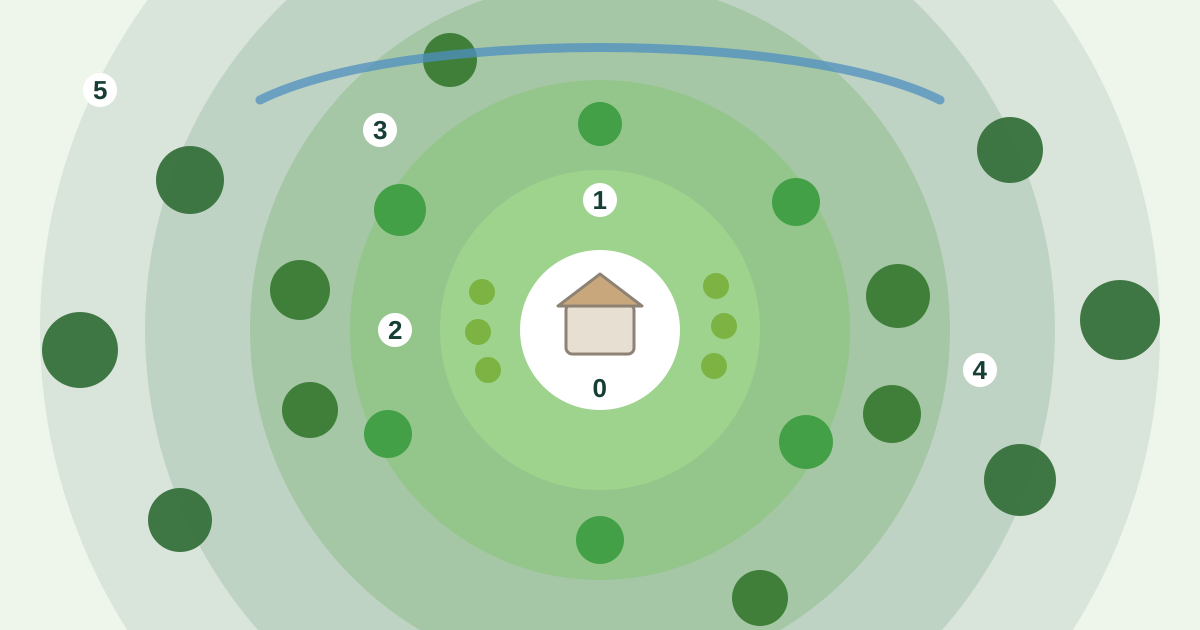
Permaculture zones are a way of deciding where each part of a garden goes, based on how often you visit it. The things you use every day sit closest to the house, and the things that look after themselves go further away. Zones are numbered from 0, the home, out to 5, wild land. Get them right and the garden takes less walking, less watering and less effort, because every plant and structure is where you'll actually notice it.
What are permaculture zones?
The idea comes from Bill Mollison, one of the founders of permaculture. His principle, as the UK Permaculture Association summarises it, is simple: anything that needs frequent observation, frequent visits, a lot of work or complex care belongs close to the centre of activity. Put it far away and you waste time and energy walking back and forth to it.
So zones are about use, not distance. A herb pot you pick from every evening is zone 1 even if it's on a balcony, and a fruit tree you visit twice a year is zone 3 even if it happens to be near the door.
Diagrams draw zones as neat circles around the house. Real ones never are. They stretch along the paths you already walk, bend around slopes and shade, and shrink where a wall or a neighbour's fence gets in the way. Treat the rings as an idea, not a template.
The zones, one by one
| Zone | How often you're there | Typical elements |
|---|---|---|
| 0 | All the time | The house: kitchen, windowsills, storage, where harvests are used |
| 1 | Several times a day | Herbs, salad greens, seedlings, worm bin, kitchen compost |
| 2 | Daily to every few days | Main vegetable beds, berry bushes, small fruit trees, chickens, compost bays |
| 3 | Weekly or seasonally | Larger fruit and nut trees, main crops, pasture |
| 4 | A few times a year | Managed woodland, firewood, foraging, mushrooms |
| 5 | Rarely, just to observe | Wild land left for nature |
Zone 0: the home
Zone 0 is the house itself, the hub everything else is planned around. It's where you cook, store tools and seeds, and use what the garden produces. It's also where the garden's water and food scraps start their journey back outside.
Zone 1: right outside the door
This is the most intensive part of the garden: the plants and jobs you deal with every day. Culinary herbs, salad greens, a few vegetables you harvest little and often, seedlings, a worm bin for kitchen scraps. If you'd stop to pick it on your way in with the shopping, it belongs in zone 1.
Zone 1 works best when it's small and easy to reach. A modest patch that's always tidy and productive beats a large one you can't keep up with.
Zone 2: the productive garden
Zone 2 is where most of the food is grown, but it doesn't need attention several times a day. Perennial vegetables, the main annual beds, berry bushes, smaller fruit trees and a food forest planted in layers all fit here. So do chickens or ducks, compost bays and beehives, which need regular but not constant care.
Zone 3: the larger plantings
Zone 3 is still productive, but it gets less tending: larger fruit and nut trees, bigger areas of staple crops, or pasture for animals. On most home plots there's no room for a real zone 3, and that's fine.
Zone 4: semi-wild
Zone 4 is lightly managed land: woodland for firewood or timber, foraging, mushrooms and occasional grazing. You visit with a purpose, a few times a year.
Zone 5: wild
Zone 5 is left to nature. You don't manage it; you go there to walk, watch and learn how the land behaves on its own. Many of the ideas you'll use in the other zones come from observing zone 5.
Zones in a small garden
Most home gardens don't have six zones, and they don't need them. A typical small plot has zone 0 (the house), zone 1 by the kitchen door and zone 2 for everything else. Even so, it's worth keeping a wild corner as a small zone 5: a patch of native plants, a log pile or a shallow water dish gives insects, birds and lizards a home.
Zone 5 doesn't have to be at the far edge, either. Some gardeners deliberately bring it close to the house so they can watch wildlife from the window.
How to map your zones, step by step
- List everything you want in the garden and next to each item write how often you'd visit it: several times a day, daily, weekly, seasonally, rarely.
- Draw a simple base map of the plot: the house, the doors you actually use, existing paths, trees, walls and the water tap.
- Mark your daily routes: from the kitchen door to the bins, the car, the clothesline. The places along these routes are natural zone 1, because you pass them anyway.
- Place the items from step 1, starting with the most-visited ones closest to the house and along those routes, then work outwards.
- Check the outside forces. Permaculture calls these sectors: sun, wind, rain and fire come from particular directions, and each one affects where things should go. For example, a hedge on the side the strong winds come from, or tall trees where their shade won't fall on the vegetable beds.
- Start with zone 1. Get the area by the door working well before you expand. It's where you'll see results first, and what you learn there shapes the rest.
Common mistakes
- Making zone 1 too big. If it takes more than a few minutes to weed, water and pick, some of it probably belongs in zone 2.
- Putting high-care plants far away. A vegetable bed at the bottom of the garden gets forgotten. Mollison's principle is exactly about this: what needs frequent care has to be close.
- Drawing perfect circles. Follow your paths, the slope and the sun, not a compass.
- Forgetting that zones change. As trees grow and your routine changes, a zone 2 area may become zone 3, or the other way round. Revisit the plan every year or two.
Planning your zones in Megumi Planner
Megumi Planner was built around this way of thinking. You can draw zones 0–5 directly over your site plan or aerial photo, then add trees, shrubs, vegetables, water and structures, each on its own layer. Sun and shade maps for any day of the year help you check the sun sector before you plant, and the plant data shows how big each tree will grow, so zone 2 doesn't turn into a shady zone 3 ten years from now.
All the tools for a whole permaculture design – zones, swales, rain and guilds – are on one page: permaculture design software.
Frequently asked questions
How many zones does a garden need?
As many as the site and your routine call for. A small urban garden may only have zones 0, 1 and 2, plus a wild corner. Larger properties may use all six.
Is zone 0 always the house?
Usually, because the house is where daily life happens. On some sites the centre of activity is somewhere else, such as a workshop, a barn or a shared community building, and zones are planned around that instead.
Can zone 5 be next to the house?
Yes. Zones describe how much you manage an area, not only how far away it is. A small wild patch near a window is a good way to watch and learn from nature every day.
Sources
- Efficient energy planning: zone, sector and slope – Permaculture Association (UK), based on Introduction to Permaculture by Bill Mollison and Reny Mia Slay
- Property Planning with Permaculture Zones – Jordan Charbonneau, Southern Exposure Seed Exchange
- Bill Mollison and Reny Mia Slay, Introduction to Permaculture, Tagari Publications, 1991
Keep reading
What Is Permaculture? Ethics, Principles and Pioneers
What permaculture is, where it came from, how Bill Mollison and David Holmgren started it, its three ethics and 12 principles, and how to use it in your garden.
How to Plan a Community Garden, Step by Step
How to plan a community garden: the group, the land and permits, the site survey, plots and shared areas, water, budget and rules – and one shared plan for all.
How to Plan a Small Garden, Step by Step
Plan a small garden that works: read the sun and shade, draw it to scale, set priorities, grow upwards, choose compact plants and water well in a hot summer.