
The Soil Food Web: How to Bring Your Garden Soil to Life
What the soil food web is, what Elaine Ingham taught about soil biology and where her ideas are debated, and ten things you can do to grow healthier soil life.
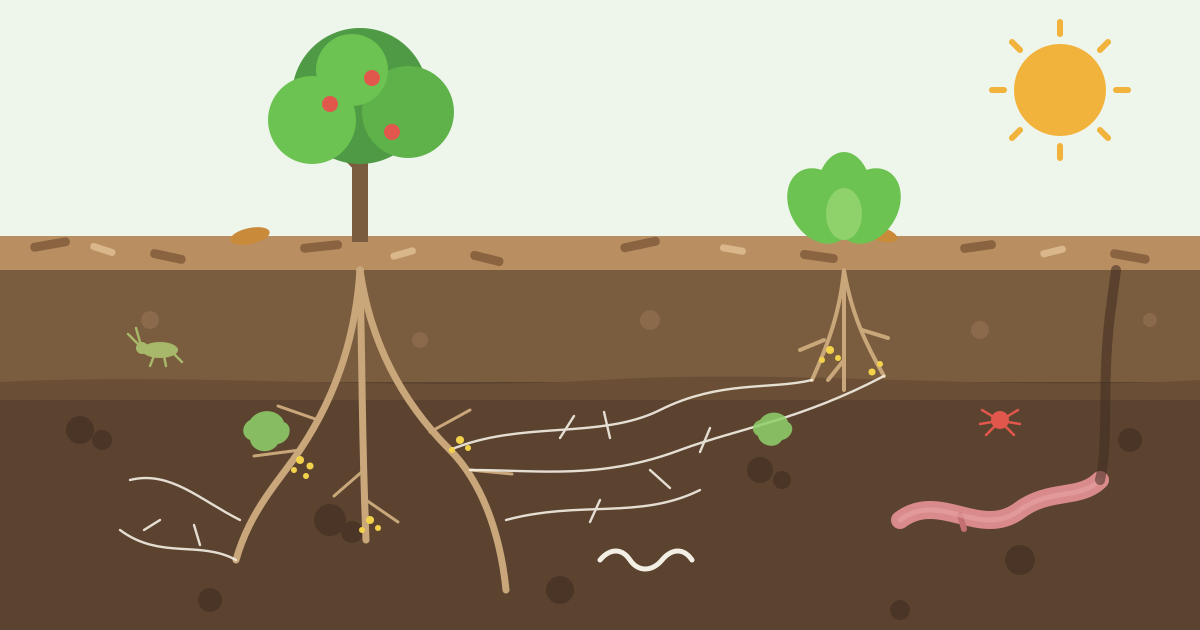
The soil food web is the community of living things in the soil – bacteria, fungi, protozoa, nematodes, mites, springtails, earthworms and many more – and the way they eat one another. Plants feed this community through their roots and dead leaves, and in return it builds soil structure, holds water and releases nutrients where roots can take them up. You can't see most of it, but you can grow it: by disturbing the soil less, keeping it covered, keeping living roots in it and feeding it compost, you build soil that does more of the work for your plants.
What the soil food web is
A teaspoon of fertile soil holds somewhere between 100 million and a billion bacteria, according to the US Department of Agriculture's Soil Biology Primer, along with metres of fungal threads, thousands of protozoa and dozens of nematodes. They are not a random crowd. They form a food web, with the same logic as the one above ground:
- Plants and dead plant matter. Plants capture the sun's energy. They feed soil life in two ways: through fallen leaves, dead roots and other residues, and through root exudates – sugars, amino acids and other compounds that living roots release into the soil around them, a zone called the rhizosphere.
- Bacteria and fungi. These are the decomposers. Bacteria feed mostly on simple compounds, such as exudates and fresh green matter. Fungi spread as fine threads called hyphae and can break down tougher material such as wood and straw. Some fungi, the mycorrhizal fungi, live in partnership with roots: they bring the plant water and phosphorus from beyond the reach of its roots, and get sugars from the plant in return.
- Protozoa and nematodes. These tiny animals graze on bacteria and fungi. Because bacteria and fungi contain more nitrogen than their grazers need, the grazers release the extra as ammonium, a form plants can use. A lot of this happens right next to roots.
- Shredders and burrowers. Mites, springtails, beetle larvae and earthworms shred dead plant matter into smaller pieces that microbes can reach, mix it into the soil, and dig channels for air and water.
- Predators. Predatory nematodes and mites, centipedes, beetles and, higher up, birds and moles keep each population in check.
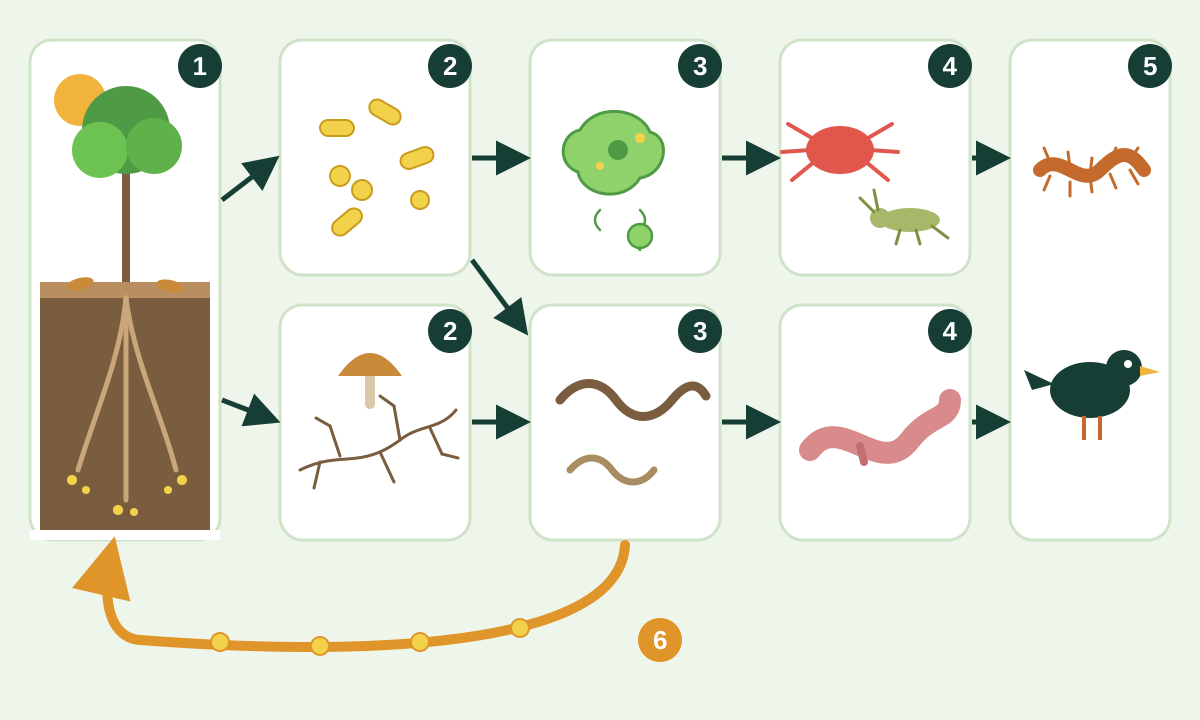
The by-products of all this eating are what gardeners care about. Bacteria and fungi glue soil particles into crumbs, called aggregates, which leave pores for air and water. Organic matter builds up. Nutrients are held in living bodies instead of washing away, then released slowly. And a busy, diverse community leaves less room for the few organisms that cause plant disease.
Elaine Ingham and the soil food web approach
The American soil microbiologist Elaine Ingham (1952–2026) did more than anyone to bring these ideas from the laboratory to gardeners and farmers. She earned her PhD at Colorado State University in 1981, researched soil organisms at Oregon State University from 1986 to 2001, and wrote much of the Soil Biology Primer that the USDA still uses to teach soil biology. She went on to found Soil Foodweb Inc., a company that tested soil biology for growers; served as chief scientist at the Rodale Institute from 2011; and from 2019 taught thousands of students worldwide through the Soil Food Web School. She retired in October 2025 and died in February 2026, aged 73.
Her teaching rests on a few main ideas:
- Soil is alive, and the biology does the feeding. In her view, a complete food web makes nutrients available to plants without the need for fertilisers, and plants steer it by choosing which exudates to release.
- Plants prefer different kinds of soil. Following the way land changes from bare ground to grassland to forest, she taught that early-succession plants such as vegetables and grasses do best in soil where bacteria and fungi are roughly balanced, while shrubs and trees prefer soil with more fungi. The measure she used is the fungal-to-bacterial (F:B) ratio.
- Bring the biology back with good compost. Well-made compost, and liquids made from it such as compost tea and compost extract, reintroduce the organisms that tillage and chemicals have killed.
- Look before you act. She trained growers to check their soil and compost under a microscope and count the bacteria, fungi, protozoa and nematodes they see.
- Stop harming it. Tillage, compaction, high doses of soluble fertiliser and pesticides all damage the food web.
What the research supports, and where it's debated
Much of this is now mainstream. The US Natural Resources Conservation Service (NRCS) bases its advice on four soil health principles that closely match Ingham's practical advice: disturb the soil as little as possible, keep it covered, keep living roots in it as much of the year as possible, and grow as many different plants as you can. The role of microbes in cycling nutrients, the release of nitrogen by protozoa and nematodes, and the value of mycorrhizal fungi are all well established in soil science.
Some parts of her approach, though, go further than the evidence:
- Fungal-to-bacterial ratios. In a 2010 review, Michael Strickland and Johannes Rousk found that the F:B ratio depends heavily on how it is measured, and that changes in it often don't line up with the theory. A 2022 review led by Mirjam Pulleman concluded that claims about the benefits of high F:B ratios can't be generalised. Specific target ratios for each crop are not supported by research.
- Compost tea. Studies, starting with a 2002 review by Steven Scheuerell and Walter Mahaffee, found that compost teas sometimes suppress plant diseases, but results vary widely from one batch to the next, and aerating the tea doesn't reliably make it work better. Linda Chalker-Scott, of Washington State University, points out that adding molasses or other sugars to the brew can feed human pathogens such as E. coli. Compost itself has much stronger evidence behind it than tea made from it.
- Microscope counts. Looking at soil under a microscope is a good way to learn, but a few drops on a slide show a very small and variable sample. Soil scientists generally don't use such counts to decide how much of each organism a soil needs.
- No fertiliser at all. Biology can make far more of the soil's own nutrients available, and a living, well-fed soil needs much less fertiliser. But a harvest still removes nutrients from the garden, and soils that are genuinely short of an element, such as phosphorus, need it added in some form.
Andrew McGuire, of Washington State University, sums up the scientific view: build a habitat for soil life and protect it, and the organisms will take care of themselves. You don't need to manage each group, measure ratios or buy inoculants. The good news for gardeners is that the practical advice from both sides is almost the same.
10 things you can do for soil life in your garden
1. Dig as little as possible
Digging and rotary tilling cut fungal threads, break up the crumbs that soil life has built, expose earthworms and speed up the loss of organic matter. Studies generally find more mycorrhizal fungi and earthworms in undug soil, although the size of the difference varies. Instead of digging a bed every season, loosen compacted soil once with a garden fork (rocking it rather than turning the soil over), then add compost and mulch on top and let the worms mix it in.
2. Keep the soil covered
Bare soil in the Israeli summer sun gets hot and dry enough to stop almost all biological activity near the surface. A layer of mulch keeps it cool and moist and feeds the decomposers as it breaks down. Wood chips under trees and shrubs encourage fungi; straw, leaves or a thin layer of compost suit vegetable beds.
3. Keep living roots in the ground
Living roots are the food web's main source of food, through their exudates. Every month a bed stands empty, soil life goes hungry. Plant perennials, sow a cover crop instead of leaving a bed bare, and when a crop is finished, cut it at the soil surface and leave the roots in the ground to rot.
4. Grow cover crops in the rainy season
In Israel, the rainy winter is the natural time for a cover crop: a mix of plants grown to feed and protect the soil rather than to harvest. Sow it with the first rains in October or November, for example a mix of a legume such as vetch (Vicia spp.) or fava beans (Vicia faba) with oats (Avena sativa) or barley (Hordeum vulgare). In spring, before the plants set seed, cut them and leave them on the surface as mulch, and plant your summer crop through it.
5. Plant a diversity of plants
Different plants release different exudates and feed different organisms. A bed with many species, a mix of annuals and perennials, and plants from different families supports a richer food web than one crop in a row. A fruit tree guild is a good example: a tree surrounded by support plants, each with its own roots. Nitrogen-fixing legumes are especially useful, because their root nodules host bacteria that turn nitrogen from the air into a form plants can use.
6. Make good compost, and use it
Compost is the most reliable way to add both organic matter and a wide range of organisms. That matters in Israel, where many soils hold less than 2% organic matter: in a long-term trial in an organic orchard in the Jezreel Valley, researchers from the Newe Ya'ar Research Center found that once compost had built up the organic matter, less of it was needed each year. Good compost smells earthy and sweet, not sour or of ammonia, and is dark and crumbly. To make it:
- Mix greens and browns. Combine nitrogen-rich "greens" (vegetable scraps, fresh grass, green prunings, manure) with carbon-rich "browns" (dry leaves, straw, wood chips, cardboard), roughly 1 part greens to 2–3 parts browns by volume. That aims for the 25–30:1 carbon-to-nitrogen ratio that composting guides recommend.
- Build it big enough. A pile of about 1 m³ (1 m wide, high and deep) holds enough heat to reach the hot stage, 55–65 °C. A few days at 55 °C or more kills most weed seeds and pathogens.
- Keep it as moist as a wrung-out sponge. In an Israeli summer, a pile dries out fast: water it, cover it, and keep it in the shade.
- Turn it. Turning a hot pile when its temperature starts to drop brings in air and heat again. After a few turns, let it cool and mature for a few months; fungi and other organisms move in during this stage.
Spread 1–2 cm of compost on beds once or twice a year, under the mulch, and add a few spadefuls to the planting hole of a new tree. If you have no space for a pile, a worm bin (vermicompost) turns kitchen scraps into rich compost in a corner of the balcony.
The Johnson-Su bioreactor, an unturned, aerated compost pile developed at New Mexico State University and promoted by Ingham, is designed to grow compost rich in fungi over about a year. It is interesting to try, but most of the claims about it so far come from its developers rather than independent trials.
7. Go easy on soluble fertilisers and pesticides
High doses of soluble fertiliser change what plants and microbes do. In particular, research shows that plants growing in phosphorus-rich soil form fewer partnerships with mycorrhizal fungi, because they don't need them. Broad-spectrum pesticides and fungicides kill beneficial organisms along with pests. Feed with compost and organic materials, test the soil before adding phosphorus, and use targeted, gentle pest control only where it's really needed. Homemade ferments such as those of Korean Natural Farming can be an addition, but not a replacement for compost and mulch.
8. Water for soil life, not only for plants
Soil organisms live in the thin films of water around soil particles. When the soil dries out, most of them go dormant; when it is waterlogged, air runs out and organisms that need oxygen die. Drip irrigation under mulch keeps the root zone steadily moist in summer without soaking it. Rainwater soaking into the soil, for example in basins and swales, brings soil life to depth over winter.
9. Don't compact the soil
Walking on beds, especially wet clay soil, squeezes out the pores that soil life needs to breathe and move. Make beds narrow enough to reach the middle from the path (about 1.2 m), keep fixed paths, and stay off the soil after heavy rain.
10. Let the garden decompose in place
Fallen leaves, pruned branches and spent plants are food for the soil. Instead of taking them away, chop them and leave them on the surface as mulch ("chop and drop"), or put them in the compost. Keep thick woody prunings for paths and under trees.
How to see the life in your soil
You don't need a laboratory to see whether your soil is coming to life. Repeat these simple checks once a year, at the same time of year, and compare:
- Count earthworms. Dig out a cube of soil 20 × 20 × 20 cm and count the worms as you break it up. Guides from pasture regions often consider 10 or more a sign of healthy soil. In Israel, count in winter after the soil has been wet for a while: in dry summer soil, worms move deep or go dormant, and sandy soils naturally have fewer.
- Smell it. Healthy soil smells of a forest floor. That earthy smell comes from geosmin, which is produced by soil bacteria called actinomycetes. A sour or rotten smell means a lack of air.
- Drop a clump in a jar of water. Put a dry, unbroken clod of soil gently into a clear jar of water. Soil with strong crumbs, glued by soil life, holds together for a long time; poor soil quickly collapses into mud. Compare a clod from a mulched bed with one from bare ground.
- Bury cotton underwear. A well-known extension test: bury a pair of 100% cotton briefs 10–15 cm deep and dig them up after about two months. The more of the fabric has been eaten, the more active the soil life. In Israel, do it in late winter or spring, or in an irrigated bed, since dry soil gives no result.
- Use a microscope. A basic microscope with 400× magnification is enough to see fungal threads, bacteria, protozoa and nematodes in a drop of soil or compost mixed with water. It's a fascinating way to learn what lives in your soil, even if it doesn't give exact numbers.
Planning it in Megumi Planner
Soil life follows the plants. In Megumi Planner you can draw your beds, paths and trees on the site plan to scale, so beds stay narrow enough to work from fixed paths and the soil in them is never walked on. The plant library helps you mix plants of different families and layers in each bed and around each tree, and you can mark where the compost pile and worm bin go, close to the kitchen and the beds that need them most.
Frequently asked questions
Is the soil food web the same as soil health?
Not quite. Soil health includes the soil's physical structure and chemistry too. But soil life builds much of that structure and drives the nutrient cycles, so a thriving food web is one of the clearest signs of healthy soil.
Do I need to buy microbes or inoculants?
Usually not. Most garden soils already contain a wide range of organisms, and they multiply once you give them food, water, air and cover. Good homemade compost adds a broad mix of organisms at no cost. Bought products, including mycorrhizal inoculants, often show no clear benefit in soils that already have living roots.
How long does it take to improve soil biology?
Some changes are quick: worms and fungi often return to a mulched bed within a season. Building organic matter and a stable crumb structure takes years. Extension reports from farmland that stopped tilling describe clear increases in microbial life within three to five years.
Is Elaine Ingham's Soil Food Web School course worth it?
Many gardeners and farmers have found the course inspiring and practical, especially for composting and microscope work. Just keep in mind which parts are well established and which, such as precise fungal-to-bacterial targets and compost tea for disease control, are still debated in the research.
Sources
- Soil Biology Primer – Elaine R. Ingham and others, USDA Natural Resources Conservation Service
- NRCS Principles for High Functioning Soils – USDA NRCS
- Elaine Ingham – Wikipedia
- Remembering Elaine Ingham, whose soil science research informed the modern gardener – Anchorage Daily News, 2026
- Considering fungal:bacterial dominance in soils – methods, controls, and ecosystem implications – Strickland and Rousk, Soil Biology and Biochemistry, 2010
- Soil biodiversity and nature-mimicry in agriculture; the power of metaphor? – Pulleman, de Boer, Giller and Kuyper, Outlook on Agriculture, 2022
- Don't Overthink Your Soil Biology – Andrew McGuire, Washington State University CSANR, 2022
- Compost tea: principles and prospects for plant disease control – Scheuerell and Mahaffee, Compost Science and Utilization 10(4), 2002
- How tillage affects soil microbe populations – Farm Progress, reporting South Dakota State University Extension
- Compost tea potential is still brewing – BioCycle, 2005 (molasses and E. coli)
- Compost Fundamentals – Utah State University Extension
- Test Your Soil Health by Burying a Pair of Briefs – Oregon State University Extension
- Earthworms – AHDB (UK), how to count earthworms
- Effects of soil P on mycorrhizal colonization of onion roots – Washington State University, 2017
- The changing needs with time for mineral nutrition of organic stone fruit orchard under Mediterranean conditions – Newe Ya'ar Research Center, Israel
Keep reading
Korean Natural Farming (KNF): DIY Natural Fertilizers
What Korean Natural Farming is, how its homemade ferments are meant to support plant growth and health, what the research shows, and how to make them at home.
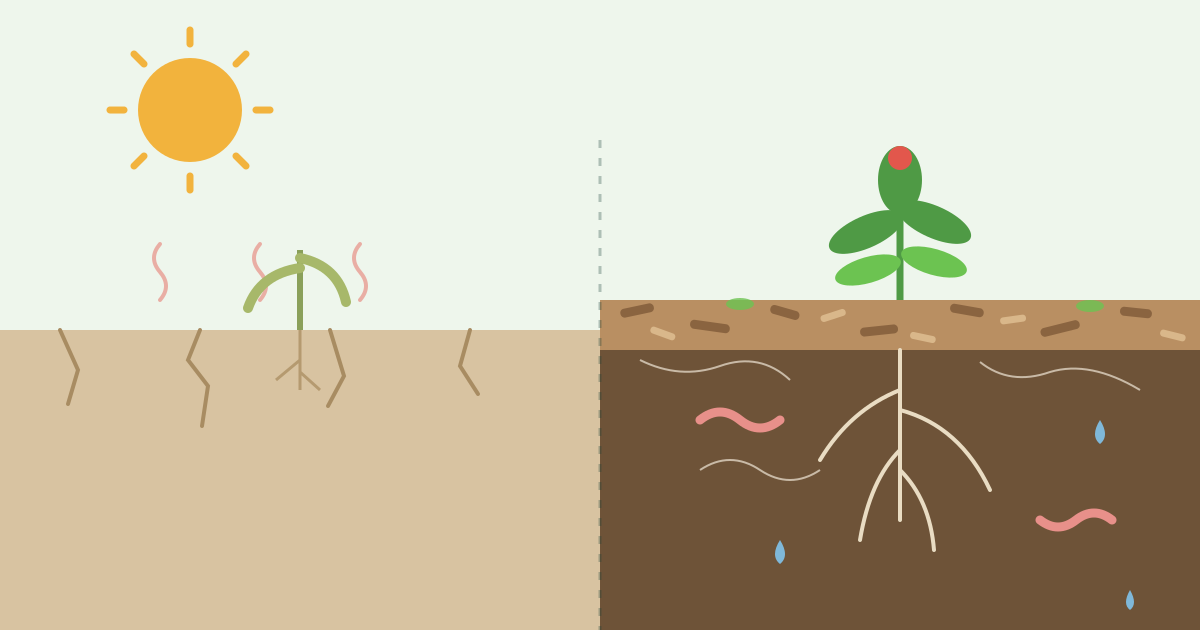
Mulch in the Garden: Why It Matters and How to Use It
Why mulch is the most useful thing you can do for garden soil, what the Back to Eden wood chip method teaches, which mulch to use where, and how deep to lay it.
What Is Permaculture? Ethics, Principles and Pioneers
What permaculture is, where it came from, how Bill Mollison and David Holmgren started it, its three ethics and 12 principles, and how to use it in your garden.