
Square Foot Gardening: Grow More Vegetables in a Small Bed
How square foot gardening works: the grid, how many plants go in each square, the soil mix, a planting chart, and how to adapt the method to a hot, dry summer.
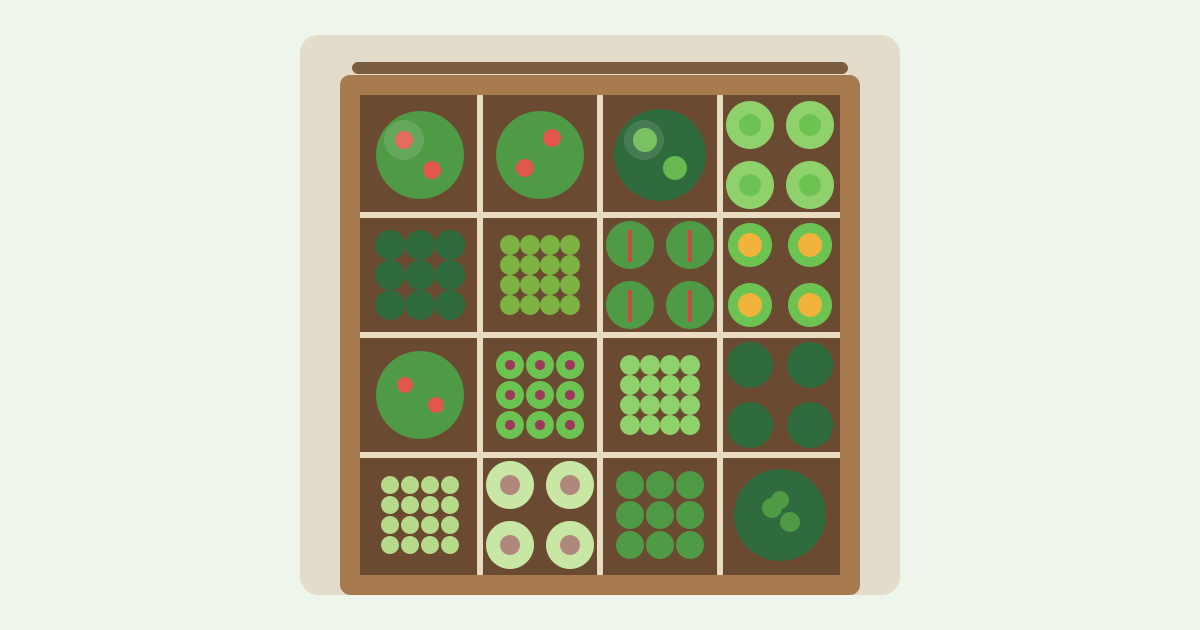
Square foot gardening is a simple way to grow a lot of vegetables in a small space: you build a shallow raised bed, divide it into a grid of 30 cm (one-foot) squares, and plant each square with a single crop, at 1, 4, 9 or 16 plants per square depending on the size of the plant. There are no rows and no paths inside the bed, so nothing is wasted, the soil is never walked on, and a bed of 1.2 × 1.2 m can keep a small household in salad and herbs for much of the year.
Where square foot gardening comes from
The method was developed by Mel Bartholomew, an American engineer who took up vegetable gardening after he retired in the mid-1970s. Watching the long rows and the hours of weeding in his community garden, he looked for a way to grow the same food in less space with less work. His book Square Foot Gardening came out in 1981 and sold well over a million copies. In 2006 he published All New Square Foot Gardening, which changed the method's biggest step: instead of digging and improving the soil underneath, you build the bed on top of the ground and fill it with a special soil mix.
How the method works
The rules are short:
- Beds of 1.2 × 1.2 m (4 × 4 feet). You can reach the middle from any side without stepping in. A bed against a wall or fence should be no more than about 60–75 cm deep, so you can still reach the back.
- A visible grid. Thin wooden slats or string divide the bed into 16 squares of 30 × 30 cm. The grid is the heart of the method: it makes you plan each square instead of scattering seeds.
- One crop per square. Each square holds one kind of plant. When it's harvested, you add a trowel of compost and replant that square with something else.
- Plant by spacing, not by rows. The number of plants in a square depends on how much room each plant needs when grown.
- Grow tall plants up. Tomatoes, cucumbers, climbing beans and small melons grow on a trellis or net along the north side of the bed, where they won't shade the rest.
- Sow a few seeds per spot, then thin to the strongest seedling. This saves seed compared with sowing a whole row.
How many plants per square
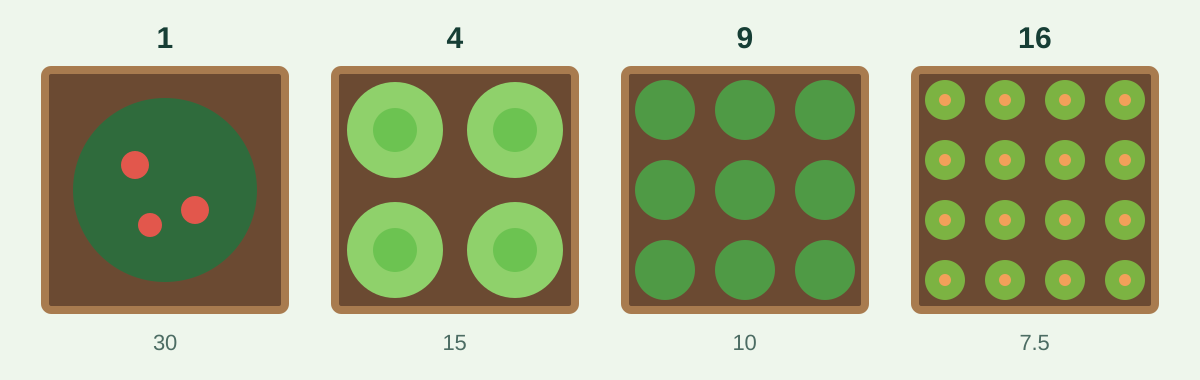
| Plants per square | Spacing | Examples |
|---|---|---|
| 1 | 30 cm | Staked tomato, pepper, eggplant, broccoli, cabbage, cauliflower |
| 4 | 15 cm | Lettuce, chard, parsley, basil, marigold |
| 9 | 10 cm | Spinach, beetroot, bush beans, turnip, garlic, peas on a trellis |
| 16 | 7.5 cm | Carrots, radishes, spring onions, small beetroot for baby leaves |
Some plants need more than one square. A zucchini or bush squash spreads over at least 2 squares and often a whole block of 4 or more, and a sprawling cherry tomato can take 2–4 squares unless you train it up a stake. Charts differ on a few crops, especially tomatoes and onions, so treat the numbers as a starting point and adjust to your varieties.
The soil mix
Bartholomew's "Mel's Mix" is one third compost, one third peat moss and one third coarse vermiculite, by volume. The compost feeds the plants, the peat holds water, and the vermiculite keeps the mix light and airy. Because the mix is so rich and loose, the method claims you only need 15 cm (6 inches) of it, and that no digging or fertiliser is needed beyond adding compost each time you replant.
Two common changes:
- Coconut coir instead of peat. Peat is harvested from bogs that store carbon and take thousands of years to form. Coir is a by-product of coconuts and works in the same way.
- Several kinds of compost. Bartholomew recommended mixing at least five different composts, for example garden compost, worm compost and composted manure, so the plants get a wider range of nutrients.
A 1.2 × 1.2 m bed, 15 cm deep, holds about 220 litres of mix. A deeper bed of 30 cm needs about 430 litres.
Building a square foot garden, step by step
- Pick the sunniest spot you have. Most vegetables need at least 6 hours of direct sun. Close to the kitchen door is ideal, because a bed you see every day gets looked after.
- Build the frame. Use untreated wood, 1.2 × 1.2 m on the inside, at least 15 cm high and preferably 25–30 cm (see below). Lay cardboard or weed cloth underneath to stop grass and weeds coming up.
- Fill it with the mix and water it well.
- Add the grid. Fix slats or strings across the top every 30 cm. Leave it in place all season.
- Lay the irrigation. A drip ring or two short drip lines across the bed before planting is much easier than adding them later.
- Plan the squares. Put tall plants and the trellis on the north side, and mix crops so no two neighbouring squares are the same plant family. Sow or plant each square at its spacing.
- Harvest one square, replant one square. Add a trowel of compost, and plant a different crop from the one that just finished.
Square foot gardening in a hot, dry climate
The method was born in the eastern United States, with summer rain and mild summers. In a Mediterranean climate like Israel's, a few changes make a big difference:
- Build deeper beds. A 15 cm layer dries out in hours on a hot day, and raised beds lose water through their sides as well as the top. A depth of 25–30 cm holds much more water and gives deep-rooted crops like tomatoes room to grow. If you want to save on mix, fill the bottom with good garden soil and keep the rich mix for the top 15 cm.
- Use drip irrigation on a timer, laid under mulch. Hand watering a small bed in a hamsin is easy to miss for a day, and a shallow bed won't forgive that.
- Mulch between the plants. Mulch isn't part of the original method, but in a hot summer a thin layer of straw or chopped leaves keeps the surface cool and cuts evaporation.
- Shade cloth for the summer. A 30–40% shade cloth over the bed in July and August helps lettuce, chard and other leafy greens survive the heat.
- Use the winter. In much of Israel, winter is the best season for leafy greens, peas, brassicas, carrots and onions, and the rain does part of the watering.
What square foot gardening is good for, and its limits
It suits beginners, small yards and balconies, rented homes, school gardens, and people who find bending to ground level hard, since a frame can be raised to table height. It produces a lot from a small area, and because each square is small and replanted often, the garden stays productive for most of the year.
It has limits too. Buying a full bed of mix, compost and vermiculite costs more than improving the soil you have. A 15 cm bed is shallow for large crops and in hot weather. And large plants such as pumpkins, corn and potatoes don't fit the grid well. Many gardeners treat the grid as a planning tool and borrow its spacing for ordinary beds in the ground, which works just as well.
Square foot beds and permaculture
A square foot bed fits naturally into zone 1, the part of the garden closest to the house that you visit every day. Put herbs and salad crops there, and a slower food forest or fruit trees further out. Water can come from rainwater collected nearby; see water harvesting in the garden.
Planning square foot beds in Megumi Planner
In Megumi Planner you can draw your beds to scale on the site plan, place them in the sunniest spots, and check how buildings and trees will shade them during the day. You can plan the drip lines that feed each bed, and the plant library gives each plant's size and spacing, which helps you work out how many fit in each square.
All the tools for raised beds and vegetables are on one page: the vegetable garden planner.
Frequently asked questions
Do I have to use Mel's Mix?
No. Any rich, light mix with plenty of compost works. In a hot climate, a deeper bed with good soil at the bottom and a compost-rich mix on top often does better than 15 cm of pure mix.
Can I make a square foot garden on a balcony?
Yes, in a box with a solid bottom and drainage holes. Check how much weight the balcony can take, because a full, wet bed is heavy.
How big should the squares be in metric?
30 × 30 cm is the closest to one foot and the easiest to work with. A bed of 1.2 × 1.2 m gives the standard 16 squares.
Can I grow tomatoes in a square foot garden?
Yes. Give a tall staked tomato one square and tie it up a strong stake or string, and give a bushy or sprawling one 2–4 squares.
Sources
- Square foot gardening: a formula for successful intensive gardening – Michigan State University Extension
- Square Foot Garden – University of Florida IFAS Extension
- How to: Square Foot Garden – UC Master Gardeners, Tulare-Kings Counties
- Square Foot Seeds – NC State Extension
- Square Foot Gardening for Small Spaces – Anoka County Master Gardeners, University of Minnesota Extension
- History – Square Foot Gardening Foundation
- Mel Bartholomew – Wikipedia
Keep reading
How to Plan a Small Garden, Step by Step
Plan a small garden that works: read the sun and shade, draw it to scale, set priorities, grow upwards, choose compact plants and water well in a hot summer.
No-Dig Raised Beds: How to Build Them and Grow Vegetables
How to build a no-dig raised bed for vegetables: size, frame, cardboard and compost layers, planting without digging, feeding, weeds and drip in hot summers.
How to Plan a Community Garden, Step by Step
How to plan a community garden: the group, the land and permits, the site survey, plots and shared areas, water, budget and rules – and one shared plan for all.