
Syntropic Agroforestry: A Beginner's Guide for Gardens
What syntropic agroforestry is, how its strata, succession and pruning work, how to start a syntropic row at home, and how to adapt it to a hot, dry summer.
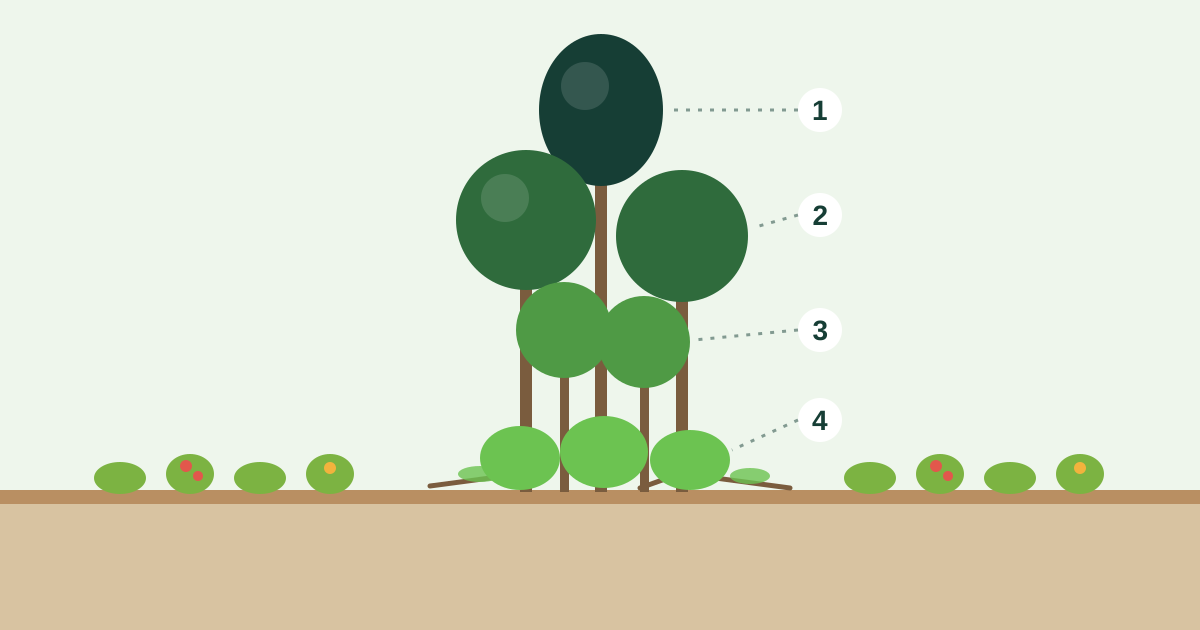
Syntropic agroforestry is a way of growing food that copies how a forest develops: you plant many species very densely, in rows, filling every height layer and every stage of succession at once, and then prune hard and often so the cut material feeds the soil. Fast plants make biomass and shelter in the first months, fruit trees take over over the years, and the system grows richer instead of more tired. It was developed by the Swiss farmer Ernst Götsch in Brazil, and it can be scaled down to a single row in a home garden.
Where syntropic farming comes from
Ernst Götsch worked in plant breeding in Zürich before he moved to Brazil. In 1984 he bought a farm in southern Bahia on land badly degraded by cattle and logging, and spent decades turning it back into productive forest, growing cocoa and other crops among native trees. His approach spread through his workshops and the short film Life in Syntropy to farms in Brazil, Europe, Australia and elsewhere.
"Syntropy" is the opposite of entropy: a system that builds up energy, structure and life over time, instead of running down. In practice that means a farm whose soil, water and diversity improve every year, with as few outside inputs as possible.
The three ideas behind it
Stratification: every height layer filled
A forest has plants at every height, each adapted to the light it gets there. Syntropic design sorts plants into strata (layers) by how high they grow relative to each other, and gives each layer a share of the space:
| Stratum | Share of the space (guideline) |
|---|---|
| Emergent, the tallest | about 20% |
| High | about 40% |
| Medium | about 60% |
| Low | about 80% |
The total is more than 100% on purpose: the layers stack above one another, so the same ground is used several times over. Treat the numbers as a guide, not a rule. Whether a plant counts as "high" or "medium" depends on what it grows next to.
Succession: every stage planted at once
Nature fills bare ground in stages, from short-lived pioneers to long-lived trees. Syntropic farming plants all the stages together and groups plants by lifespan:
- Placenta: annuals and biennials that live from a few months to two years, such as vegetables, maize, beans and sunflowers.
- Secondary: trees and shrubs that live from a few years to a few decades, such as banana, papaya, pigeon pea and many fruit trees.
- Climax: long-lived trees that last many decades, such as walnut, carob, avocado and oaks.
A good consortium, the group planted together in one spot, has plants from several strata and several lifespans, so that there is always something filling each layer as the earlier plants finish their lives.
Pruning: the fuel of the system
Götsch calls pruning the fuel that drives the system forward. Plants are cut back regularly, and the cut branches and leaves are laid on the ground. This does three jobs: it feeds the soil with a constant supply of mulch, it opens light for the plants below, and it renews the growth of the plants that were cut. Fast-growing "biomass plants" are planted for this purpose alone.
How a syntropic garden is laid out
Most syntropic systems are built in tree lines: rows about 1 m wide where trees and shrubs from all strata are planted closely together, with inter-rows between them for vegetables and other short crops. A Restore Nature project in southern Portugal, for example, uses 3 m between lines and runs them north–south, so both sides of each line get sun during the day.
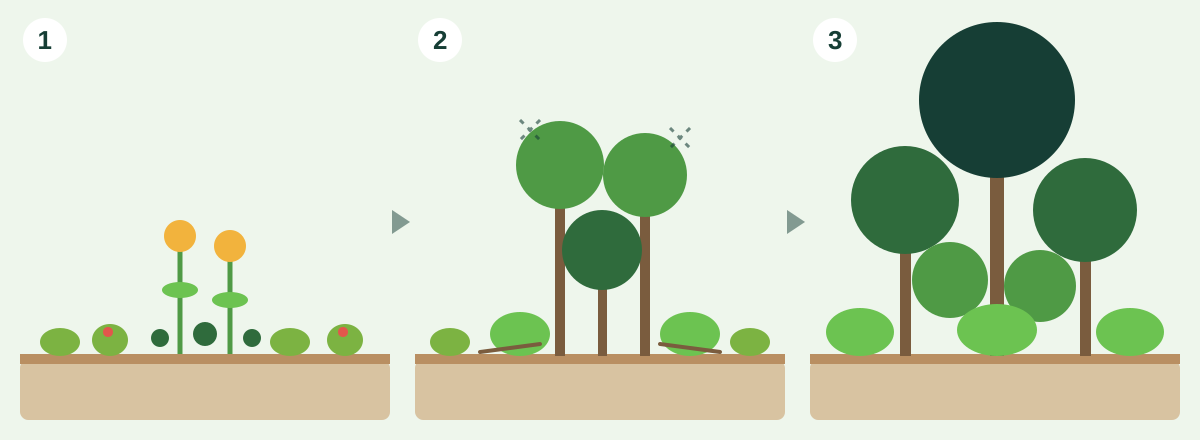
The system moves on as it grows. As the trees shade the inter-rows, vegetables move to newer lines and the older area becomes a fruit forest. In a 2018 workshop in Portugal, Götsch's team turned a 50-year-old olive grove into a syntropic system: they started with beds only about 40 cm wide, as much as the existing organic matter could cover, and planned to widen them as the soil improved, adding fruit and nut trees about every 3 m along the lines.
Starting a syntropic row at home
- Pick a sunny strip at least 5–6 m long, and run it roughly north–south if you can.
- Prepare the soil. Loosen it, spread compost, and cover everything with a thick mulch. In a dry climate, lay a drip line along the row now.
- Choose a consortium with plants from every stratum and every lifespan (see the table below), suited to your climate and your taste.
- Plant everything at once, densely. Trees and shrubs go into the line, about 50 cm–1 m apart along the row, with seeds of fast annuals and biomass plants between them. Vegetables go in the beds on both sides.
- Prune often. Cut the biomass plants whenever they start to shade plants that need light, and do a major pruning of deciduous trees in winter. Chop the cuttings and lay them on the beds.
- Harvest and replant. As vegetables finish, sow new ones; as shade grows, move the vegetables outwards and let the line become a small food forest.
An example consortium for a Mediterranean garden
These are examples, not a fixed recipe. Choose plants that suit your area and that you want to eat.
| Stratum | Placenta (first months) | Secondary (years) | Climax (decades) |
|---|---|---|---|
| Emergent | Sunflower, maize | Moringa (frost-free areas) | Date palm, pecan |
| High | Sorghum | Pigeon pea, banana (well-watered spots) | Carob, mulberry, avocado |
| Medium | Staked tomatoes, okra | Papaya (warm coast), pomegranate | Citrus, fig |
| Low | Beans, squash, lettuce | Strawberries, comfrey | Sage, thyme |
Syntropic farming in a hot, dry summer
Götsch developed the method in the humid tropics, where pruning and mulch can replace irrigation and fertiliser on his farm. In a Mediterranean climate with six dry months, expect to irrigate, at least for the first years and for water-loving plants like banana and avocado. The dense planting, permanent soil cover and constant mulch do reduce water loss: a farmer at Terra Sintrópica in Mértola, one of the driest parts of Portugal, has said in interviews that he cut his irrigation sharply after switching to syntropic methods. That is one farm's report, not a measured trial.
A few practical adjustments help:
- Prune deciduous plants in winter, when the cuttings rot down in the rain, and prune lightly in summer, when shade is protecting the soil.
- Keep the mulch thick all summer, and lay drip lines under it.
- Use local and drought-tolerant plants for the long-lived layers, such as carob, olive, fig, pomegranate and mulberry.
- Collect rainwater into the system with swales and basins (see water harvesting in the garden).
What the research says
A review in The Lancet Planetary Health (Jacobi and colleagues, 2025) brought together 67 studies of syntropic farming. Most come from the tropics; research from temperate and dry climates is still scarce. The studies consistently report high crop diversity, nutritional diversity and crop quality, and favourable effects on soil fertility, carbon storage and water cycling. Yields compared with other farming systems were mixed. The method also demands a lot of knowledge and hand labour, especially for pruning.
Syntropic agroforestry, food forests and Miyawaki forests
All three are layered systems that learn from forests, but they differ in how they're managed:
| Syntropic agroforestry | Food forest | Miyawaki forest | |
|---|---|---|---|
| Goal | High production that builds soil | Food with little ongoing work | A native ecosystem |
| Layout | Dense rows with crop beds between | Clusters and guilds | A dense block |
| Plants | Crops, fruit trees and biomass plants | Fruit, nut and support plants | Local native species only |
| Work | Frequent, heavy pruning | Moderate | Watering and weeding for 2–3 years |
A syntropic row suits the productive zones close to the house, zones 1 and 2, because it needs frequent attention. If you want a wilder, hands-off planting for the edge of the garden, read about Miyawaki forests.
Planning syntropic rows in Megumi Planner
In Megumi Planner you can draw tree lines and the beds between them on your site plan, and check which way the rows run in relation to the sun. The plant library shows each plant's height, so you can check that every stratum of a line is filled, and the layer view shows how the tall trees will shade the beds around them as they grow.
All the tools for designing in layers are on one page: the food forest planner.
Frequently asked questions
Is syntropic farming the same as permaculture?
No. They share many ideas, such as layers, soil cover and working with nature, but syntropic agroforestry is a separate method developed by Ernst Götsch, with its own rules about strata, succession and especially pruning. Many permaculture gardeners use syntropic rows as one element of their design.
Do I need a big plot?
No. A single line with a bed on each side, about 5 m long, is enough to learn the method.
How much work does it take?
More than a food forest, especially in the first years. Pruning is the main job, and the biomass plants need cutting several times a year.
Can I use syntropic methods with vegetables only?
The vegetable beds are part of the system, but the method depends on the trees and biomass plants in the lines to produce mulch and shelter. Without them, it becomes ordinary mulched vegetable growing.
Sources
- Syntropic farming systems for reconciling productivity, ecosystem functions, and restoration – Jacobi et al., The Lancet Planetary Health, 2025
- Beyond Agroforestry? An Introduction to Syntropic Farming – ARC2020
- Pruning instead of fertilizers and irrigation – Felipe Pasini, Agenda Götsch
- Design for the Mediterranean: enriching an olive grove – Agenda Götsch
- What is Syntropic Farming? – Dayana Andrade and Felipe Pasini, Agenda Götsch
- What is Syntropic Farming? – Rancho Mastatal
- Restore Nature in Southern Portugal: syntropic area – Restore Nature Foundation
- Syntropic agroforestry: farming like a forest – Deep Seed podcast, with António Coelho of Terra Sintrópica
Keep reading
Mulch in the Garden: Why It Matters and How to Use It
Why mulch is the most useful thing you can do for garden soil, what the Back to Eden wood chip method teaches, which mulch to use where, and how deep to lay it.
Miyawaki Forest: How to Plant a Tiny Native Forest
What the Miyawaki method is, how to plant a dense mini forest of native trees step by step, what the evidence says, and how it fits a Mediterranean garden.
Fruit Tree Guilds: How to Plant a Permaculture Guild
What a permaculture guild is, the jobs each plant does around a fruit tree, example guilds for a dry Mediterranean garden, and how to plant one step by step.